

What is a proxy in web scraping, and why does it matter?
A proxy is an intermediary server that routes your scraper's requests through a different IP address before they reach the target site. Without one, every request originates from the same IP, which makes rate limiting, temporary bans, and CAPTCHAs nearly inevitable at any real volume. Proxies distribute that request load across many IPs, so no single address accumulates enough traffic to trigger a block.
Beyond ban avoidance, proxies solve a second problem: geo-restricted content. A target site may serve different prices, product listings, or search results depending on the visitor's apparent location. By routing through an IP in the relevant region, your scraper sees exactly what a local user would see.
Key functions proxies serve in a scraping pipeline:
- IP masking: hides your scraper's origin address from the target server
- Request distribution: spreads load across a pool so no single IP hits rate limits
- Geo-targeting: localizes your apparent location to access region-specific data
- Session management: sticky sessions preserve login state across multi-step flows
- Rotation: automatic IP switching keeps each address well under detection thresholds
rotatingproxyhub is one example of a rotating datacenter proxy provider built specifically for these workflows, offering a pool of over 50,000 IPs with automatic rotation and unlimited bandwidth.
Types of proxies used for web scraping
Choosing the wrong proxy type is one of the fastest ways to burn budget and get blocked. Each type carries a different balance of cost, detection risk, and appropriate use case.
Residential proxies
Residential proxies route traffic through real consumer ISP connections. Target sites see them as ordinary home users, which makes them harder to detect and block. The trade-off is cost: residential IPs are significantly more expensive than datacenter alternatives, and pool quality varies widely between providers.
Datacenter proxies
Datacenter proxies originate from server infrastructure rather than consumer connections. They are fast, cheap, and available in large pools, but websites with aggressive anti-bot systems can identify and block server IP ranges quickly. For targets without sophisticated detection, they remain the most cost-effective option.
Mobile proxies
Mobile proxies use IPs assigned by cellular carriers. They carry the highest trust level with most anti-bot systems and are useful for scraping platforms that specifically flag non-mobile traffic. They are also the most expensive category.
Static vs. rotating proxies
A static IP stays constant across requests, which suits long-running authenticated sessions. Rotating proxies assign a different address per request or on a time interval, which is the standard approach for high-volume scraping.

Protocol support: HTTP(S) vs. SOCKS5
HTTP/HTTPS proxies work with every major scraping library by default. SOCKS5 operates at a lower network level and can carry any TCP traffic, making it useful when you run tools beyond plain HTTP requests. Most providers support both.
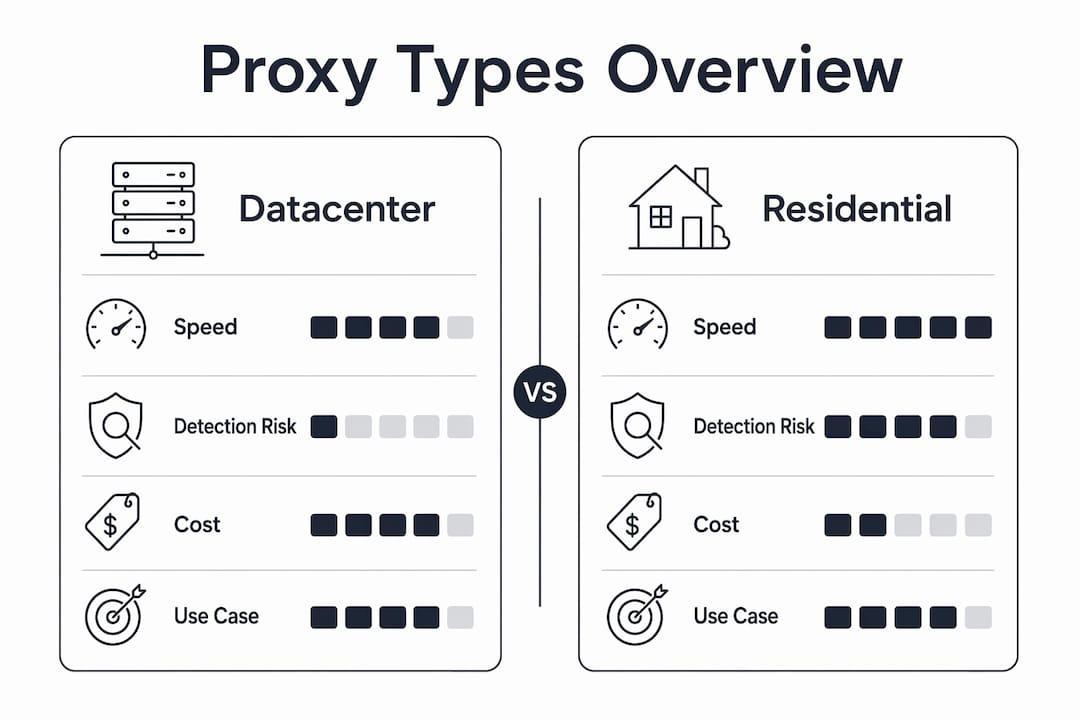
| Proxy type | Speed | Detection risk | Relative cost | Best use case |
|---|---|---|---|---|
| Datacenter | High | Higher | Low | Price monitoring, public data |
| Residential | Medium | Lower | High | Protected targets, geo-data |
| Mobile | Medium | Lowest | Highest | Mobile-first platforms |
| Static | High | Varies | Medium | Authenticated sessions |
| Rotating | Varies | Lower | Varies | High-volume scraping |
How proxies help manage web scraping challenges
The core challenge in scraping at scale is not parsing HTML. It is keeping requests flowing without triggering detection. Proxies address this at several layers.
IP ban prevention works by distributing requests so that no single address sends enough traffic to cross a site's rate threshold. A sufficiently large pool, rotating per request, keeps each IP's load minimal. Proxy quality matters here: a large pool of heavily abused IPs performs worse than a smaller, well-filtered one because target sites already distrust addresses with a poor reputation.
Rotation strategy also determines success. Three patterns cover most scenarios:
- Per-request rotation: a new IP for every request; best for stateless scraping like search results or listing pages
- Sticky sessions: the same IP held for a sequence of related requests; necessary when a site ties session state to an IP
- Time-based rotation: the pool refreshes on an interval; convenient for long-running crawls without manual management
Pro Tip: Treat HTTP 403 and 429 responses as routing signals, not failures. When your scraper receives either code, rotate and retry with a different IP rather than aborting the request. This single change sustains throughput through temporary blocks without losing the URL. Combining proxies with realistic browser fingerprinting adds another layer of protection. Modern anti-bot systems inspect TLS fingerprints, User-Agent strings, and header order alongside IP reputation. A clean proxy paired with a suspicious browser signature can still trigger a block.
How to choose the right proxy type and provider
Matching proxy type to your specific target and workflow prevents wasted spend. A few practical criteria narrow the field quickly.
Assess your target's anti-bot sophistication. Public data APIs and simple listing pages rarely need residential IPs. Platforms like Amazon, LinkedIn, or major social networks actively flag datacenter ranges and require residential or mobile proxies for sustained access.
Match rotation strategy to session requirements. Stateless scraping (product listings, SERP data) works well with per-request rotation. Multi-step flows (login, cart, checkout) need sticky sessions to avoid breaking state mid-sequence.
Evaluate provider infrastructure on these criteria:
- IP pool size and geographic distribution
- Rotation method and session control options
- Latency: lower latency directly increases concurrency and pages-per-minute at the same thread count
- Protocol support (HTTP/S and SOCKS5)
- Bandwidth model: unlimited vs. metered (metered billing turns every retry into a cost decision)
- SLA guarantees and support responsiveness
Run a small benchmark before committing. Test a sample of proxies against your actual target, not a generic endpoint. Measure success rate and latency under realistic concurrency. Proxy selection should be driven by fit-for-purpose performance, not pool size alone.
rotatingproxyhub's rotating datacenter proxies support up to 2,000 concurrent threads with HTTP/S and SOCKS5 protocols, making them a practical fit for high-volume scraping workflows where datacenter IPs are sufficient.
rotatingproxyhub: rotating datacenter proxies for web scraping
rotatingproxyhub's infrastructure is built around the requirements of production scraping pipelines. The key specifications:
| Feature | Detail |
|---|---|
| IP pool size | 50,000+ rotating datacenter IPs |
| Bandwidth | Unlimited |
| Protocols | HTTP/S and SOCKS5 |
| Concurrency | Up to 2,000 threads |
| Session modes | Rotating and sticky sessions |
| Success rate | 99% request success rate |
| Pricing | Tiered plans by concurrency and usage |
Users running e-commerce and digital marketing scraping projects report improved extraction efficiency and fewer bans after switching to rotatingproxyhub's rotating proxies. The service integrates with standard scraping tools through the IP:PORT format, with access granted via IP binding or credential-based authentication.
rotatingproxyhub's pricing model uses tiered plans based on concurrency and usage requirements, which suits both small-scale projects and high-volume operations without forcing developers into bandwidth-based billing that penalizes retries.
How to integrate proxies into your scraping setup
Integration follows the same pattern across most Python scraping libraries. The proxy is passed as a dictionary or middleware configuration, and rotation logic sits between the request and the target.
With the requests library, pass a proxy dict directly:
import requests, random

proxy_list = ["http://ip1:port", "http://ip2:port", "http://ip3:port"]

def get_with_rotation(url, retries=3):
    for _ in range(retries):
        proxy = random.choice(proxy_list)
        try:
            r = requests.get(url, proxies={"http": proxy, "https": proxy}, timeout=15)
            if r.status_code in (403, 429):
                continue  # rotate on block signal
            return r
        except requests.RequestException:
            continue
    return None
With Scrapy, rotation belongs in a downloader middleware so spiders stay clean. Combine it with Scrapy's built-in RetryMiddleware and AutoThrottle to spread load and swap addresses when one gets flagged.
With aiohttp for async scraping, pass the proxy per-request inside a Semaphore-controlled coroutine. The semaphore prevents firing too many simultaneous requests, which burns addresses faster than rotation can compensate.
Keep credentials and proxy lists in environment variables or an untracked config file. Never hardcode them in the repository.
Best practices to avoid detection and IP bans
Proxies alone do not guarantee undetected scraping. Detection systems in 2026 analyze behavior, fingerprints, and timing patterns alongside IP reputation. These practices reduce exposure across all layers:
- Rotate User-Agent strings alongside IPs. Sending thousands of requests with the same browser signature is a strong detection signal even when IPs vary.
- Randomize request delays. Real users do not browse with machine-perfect timing. Add jitter between requests rather than a fixed interval.
- Use exponential backoff with jitter when a target pushes back. A fixed retry delay synchronizes the next burst and amplifies the problem.
- Cap retries per URL. Infinite retries on a blocked page tie up threads without recovering data.
- Separate proxy pools by target. An IP burned on one site should not carry that reputation to another.
- Monitor success rate across the pool. A drop in good responses across all IPs signals a rate or fingerprint problem, not a proxy failure. Slow down before adding more IPs.
- Match TLS fingerprints to the declared browser. Advanced anti-bot systems inspect TLS handshake details. Tools like
curl-impersonateor modified headless browsers help mimic real browser TLS signatures. - Avoid free proxies entirely. Most are already blacklisted or shared among thousands of bots before you send a single request.
Legal and ethical considerations when using proxies in web scraping
Proxies are a technical tool, and their legality depends entirely on how they are used, not the tool itself. Several considerations apply to any scraping operation:
Terms of service. Most websites prohibit automated access in their terms. Violating these terms may expose you to civil liability even when no law is broken. Review the target site's terms before scraping at scale.
The Computer Fraud and Abuse Act (CFAA). In the United States, accessing a computer system without authorization is a federal offense under the CFAA. Courts have debated whether scraping publicly accessible data constitutes unauthorized access, and the legal landscape continues to evolve. Consult legal counsel for high-stakes operations.
Data privacy regulations. Scraping personal data from EU-based sites may implicate GDPR. Scraping data about California residents may trigger CCPA obligations. The geographic location of the data subject, not just the scraper, determines which rules apply.
Robots.txt. While not legally binding in most jurisdictions, respecting robots.txt directives is standard professional practice and reduces legal exposure.
Rate limiting as a signal. Scraping at a rate that degrades a site's performance for other users creates liability exposure beyond terms-of-service violations. Keep request rates reasonable relative to the target's capacity.
rotatingproxyhub gives you the proxy infrastructure to scrape at scale
Most scraping failures trace back to the same root cause: the wrong proxy infrastructure for the job. rotatingproxyhub's rotating datacenter proxy service addresses this directly. With over 50,000 IPs, unlimited bandwidth, and support for up to 2,000 concurrent threads, it handles high-volume workflows without the per-gigabyte billing that penalizes retries and error handling. HTTP/S and SOCKS5 support means it integrates with any scraping stack, from requests and aiohttp to Scrapy and Playwright-based setups. The 99% request success rate reflects a pool maintained for production use, not a shared network where you inherit other users' bans. rotatingproxyhub's tiered plans scale with your concurrency requirements, so you pay for what you actually run. Start with a plan that fits your current volume, benchmark it against your targets, and scale from there. Explore rotatingproxyhub's plans to find the right fit for your scraping operation.
Key Takeaways
Effective web scraping with proxies depends on matching proxy type, rotation strategy, and provider quality to your specific targets and workflow requirements.
| Point | Details |
|---|---|
| Proxy type selection | Datacenter proxies suit simple targets; residential IPs are needed for sites with aggressive anti-bot detection. |
| Rotation strategy | Per-request rotation fits stateless scraping; sticky sessions are required for multi-step or authenticated flows. |
| Quality over quantity | A smaller pool of clean IPs outperforms a large pool of abused addresses on protected targets. |
| Error handling | HTTP 403 and 429 responses should trigger IP rotation and retry, not request termination. |
| rotatingproxyhub | Offers 50,000+ rotating datacenter IPs, unlimited bandwidth, and a 99% success rate for high-volume scraping workflows. |