

Pick sticky sessions for anything that logs in, fills a cart, or holds state across multiple steps. Pick rotating sessions for large-scale, independent requests like catalog scraping or SERP collection. The reasoning is simple: sticky preserves the session continuity a stateful workflow needs, while rotating maximizes IP diversity for jobs where every request stands alone.
- Sticky wins on session continuity but limits how many requests you can push through one IP before it gets flagged.
- Rotating wins on scale and detection resistance per IP but breaks any flow that depends on a consistent identity.
Most production pipelines use both. That's not a compromise. It's standard architecture.
Key Takeaways
Choosing between sticky and rotating proxies comes down to whether your workflow needs to hold state across requests or not.
| Point | Details |
|---|---|
| Match mode to workflow | Use sticky for logins, checkouts, and multi-step forms; use rotating for independent, high-volume requests. |
| Know your TTL | Sticky sessions typically hold an IP for 1 to 30 minutes, so test your provider's actual default before building long flows. |
| Watch for IP-mismatch | Switching IPs mid-session is the most common cause of silent automation failures in authenticated workflows. |
| Recycle, don't retry | Swap the session ID after a 429 or 403 instead of retrying the same flagged IP. |
| One pool, two modes | Rotatingproxyhub supports sticky and rotating sessions from the same IP pool under one set of credentials. |
What Are Sticky Proxies and How Do Sticky Sessions Work?
A sticky session pins one exit IP to a session identifier for a set time window, called a TTL. Every request tagged with that identifier routes through the same IP until the TTL expires or you release it manually. That's the mechanical answer to what are sticky proxies: a temporary reservation, not a permanent assignment.
Rotating sessions do the opposite. Each request, or each short interval, gets assigned a fresh IP pulled from the pool. There's no persistent identity to track, which is exactly the point for stateless jobs.
- Sticky session: session token plus pinned IP for a defined TTL.
- Rotating session: new exit IP per request or per short interval, no persistent binding.
- Typical TTL range: 1 to 30 minutes, though some providers default sesstime to 1,800 seconds when unspecified.
Pro Tip: Always test your provider's actual TTL behavior before building a long workflow around it. "30 minutes" on the docs page sometimes means 30 minutes of idle time, not 30 minutes of active use.
How Does Gateway-Level Session Selection Actually Work?
The proxy gateway decides which exit IP to hand out based on what it sees in the request. For sticky mode, it usually hashes a session identifier and maps that hash to a specific IP for the TTL window. For rotating mode, it just pulls the next available IP from the pool, no hashing required, no memory of what came before.
That session identifier typically lives inside the proxy username string. Providers commonly use a format like -session-{id}-country-{CC} to force sticky behavior without a separate API call, sometimes pairing it with a sesstime parameter to control the TTL directly. A basic authenticated request might look like this in pseudocode:
username = "user-session-8842-country-US-sesstime-15"
password = "yourpassword"
- If
sessidis present, the gateway pins the IP. - If it's absent, the gateway treats the request as rotating by default.
sesstimeoverrides the provider's default TTL when you need a shorter or longer window.
Pro Tip: Keep your client-side session cookies and your proxy session token on the same clock. If the proxy session expires before the target site's cookie does, you'll get a silent IP-mismatch failure that looks like a random logout.
Sticky vs Rotating Proxies: Comparing the Tradeoffs
Both modes draw from the same IP pool, so the decision isn't about buying a different product. It's about which parameter you set per request.
| Dimension | Sticky | Rotating |
|---|---|---|
| Best for | Logins, checkouts, multi-step forms | Catalog scraping, SERP collection, monitoring |
| Session continuity / logins | Strong, holds state for the TTL | None, breaks any login flow |
| Anti-bot / detection resistance | Depends on request pacing per IP | Strong, spreads load across many IPs |
| Speed / latency | Comparable, no extra overhead | Comparable, no extra overhead |
| IP consumption / cost | Lower per session, reused IP | Higher IP churn, more addresses touched |
| Geo-targeting / location stability | Stable location for the whole session | Stable per request, may shift within a country pool |
| Implementation complexity | Requires session token management | Simpler, often no parameters needed |
The advantages line up with the job. Sticky sessions preserve authenticated state and reduce redundant logins, but push too many requests through one IP and you'll trip rate limits fast. Rotating sessions spread that risk across the whole pool, but rotation alone doesn't guarantee anonymity, since TLS fingerprints and behavioral signals still expose bot traffic even when the IP changes every time.
A few concrete mappings: logging into a dashboard and pulling data behind it calls for sticky. Crawling ten thousand product pages on an e-commerce site calls for rotating. Geo-testing ad placements across five countries calls for rotating with country targeting. Automating a multi-step checkout flow to verify pricing calls for sticky, full stop.
How Do You Decide Between Sticky and Rotating for Your Task?
Run through this checklist before writing a single line of scraper code:
- Is the flow stateful? If the target site tracks a session cookie across more than one request, use sticky.
- Does the target bind tokens to IP? Some platforms invalidate a session the moment the source IP changes. That's a hard sticky requirement.
- Are requests independent? If each page load stands alone with no shared state, rotating is simpler and cheaper per session.
- What's your request volume per target? High volume against a single domain favors rotating to avoid concentrating risk on one IP.
Red flags that signal you picked wrong: repeated 403s right after a login step (sticky needed, not rotating), or a single IP getting blocked within minutes of steady traffic (rotating needed, not sticky). Provider session caps matter too. Push past the recommended TTL window or reuse a flagged IP too many times and you'll see silent failures that look like target-side bugs.
Hybrid pipelines are common: rotating handles bulk product-page crawling while a separate sticky session manages the authenticated account check on the same site. Nothing wrong with running both in the same script.
How Do You Implement Session Handling Without Wasting Bandwidth?
Most client libraries and scraping tools let you set the session parameter directly in the proxy username, so start there rather than hunting for a separate API call. Match thread count to session count, one thread per sticky session, so you're not accidentally routing concurrent requests through a session token meant for a single sequential flow.
- Set
sessidandsesstimeexplicitly rather than trusting provider defaults. - Recycle the session ID immediately on a 429 or 403 response instead of retrying on the same flagged IP.
- Pace requests through a single sticky IP to stay in a plausible range for human browsing, rather than firing dozens of requests per second.
- Monitor per-session success rates, not just overall success rates, to catch a bad IP before it burns your whole batch.
Pro Tip: Build your retry logic to swap the session ID, not just retry the same request. Retrying with the same sticky session against a site that already flagged it just wastes another request cycle. Cost and performance both hinge on IP churn. Rotating sessions consume more distinct IPs per job, which matters if your provider meters by IP touched rather than by bandwidth. Sticky sessions reuse one IP longer, which is cheaper per session but riskier if that IP gets burned mid-flow.
Why IP-Mismatch Is the Most Common Automation Failure
Servers frequently invalidate a session the moment the request's source IP changes mid-flow, even when the session cookie itself is still valid. This happens because many platforms bind the session token to the IP that created it as a fraud-prevention measure, so a login on IP A followed by a data request on IP B often triggers a silent re-authentication or outright rejection.
A typical case: a script logs in successfully, then switches to rotating mode for the scraping step to save cost. The next request lands on a different IP, the target site invalidates the session, and the script starts scraping a logged-out page without throwing an obvious error.
Test for this directly:
- Log in using a sticky session and capture the session cookie.
- Send the next request through a different IP and check whether the response reflects a logged-out state.
- Repeat the same flow entirely on sticky and confirm the session holds.
If step 2 fails and step 3 succeeds, IP-mismatch is your problem, and sticky sessions are the fix, not a workaround.
A Practical Take on Running Both Modes in Production
In practice, the split is straightforward: rotating handles bulk crawling where every request is disposable, sticky handles anything involving a login, a cart, or a multi-step form. Treating them as one product with two settings, rather than two separate tools, is what keeps a scraping pipeline from breaking every time a target site tightens its session rules.
For account-level operations that carry real risk, like managing logged-in sessions at scale, pairing a sticky session with a consistent browser fingerprint matters as much as the IP itself. An IP that never changes but a fingerprint that shifts every request is still an obvious mismatch to a well-built detection system.
Why a Single Proxy Endpoint for Both Modes Cuts Engineering Time
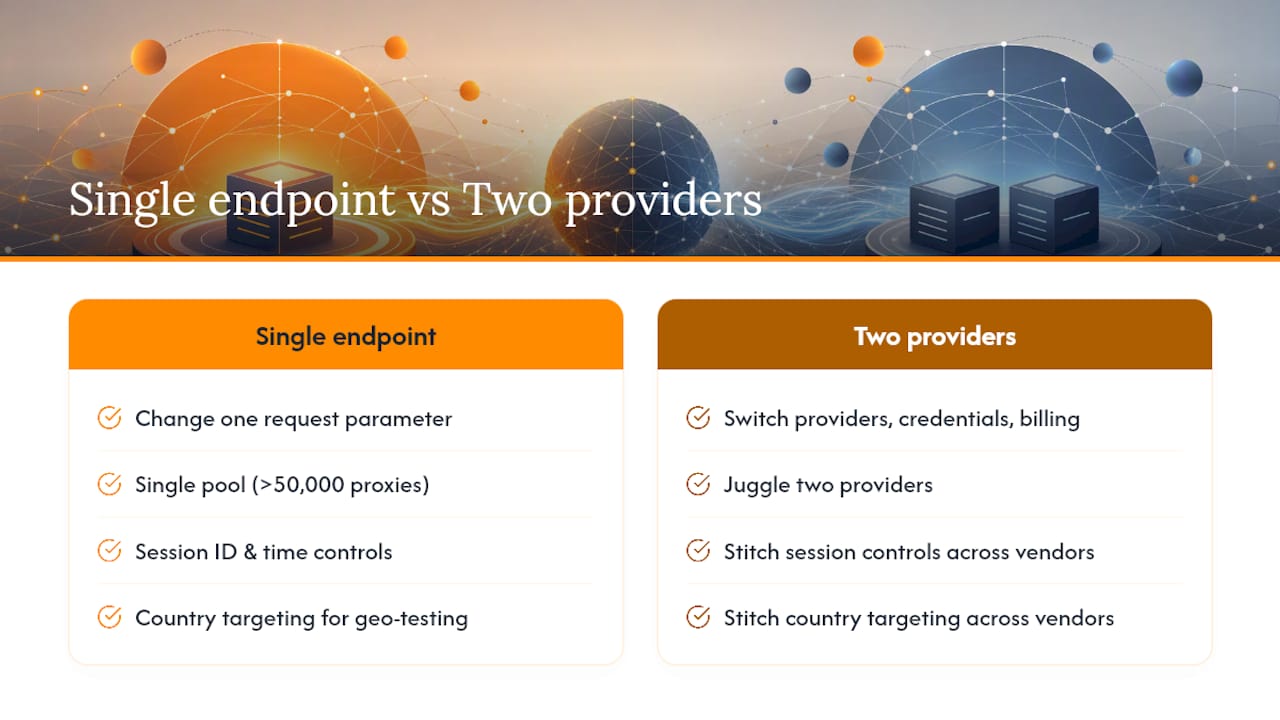
Switching between sticky and rotating shouldn't mean switching providers, credentials, or billing plans. It should mean changing one parameter in your request. Rotatingproxyhub runs both modes from the same pool of over 50,000 proxies, so a developer can move a workflow from bulk crawling to a sticky, logged-in session without touching authentication or renegotiating access.
That matters because the capabilities that make sticky and rotating work well are the same ones you'd otherwise have to stitch together across vendors: session ID and session time controls, country targeting for geo-testing, API and dashboard access for whichever fits your stack, and concurrency limits sized to how many parallel sessions your job actually needs. Rotatingproxyhub builds all of that into one rotating datacenter proxy service with HTTP/S and SOCKS5 support, so the mode you pick is a request-level decision, not a procurement decision.
If your pipeline currently juggles two providers to get both session types, try switching modes on a single pool and see how much integration work disappears.
Frequently Asked Questions
Is sticky or rotating better for web scraping? It depends on the task. Rotating suits large-scale, independent scraping like product listings or search results, while sticky suits scraping that happens behind a login.
How long does a sticky proxy session last? Most providers set a TTL between 1 and 30 minutes, though you can often override it with a session-time parameter.
Can I use both sticky and rotating proxies in the same project? Yes. Hybrid pipelines that rotate for bulk collection and stick for authenticated steps are standard practice, not a workaround.
Why does my sticky session keep breaking? The usual cause is IP-mismatch: something in your pipeline is sending part of the flow through a different IP than the one that started the session.
Do rotating proxies work for geo-targeted testing? Yes, as long as the provider supports country-level targeting within the rotation, which keeps each request in the right region even as the IP changes.