

Run one isolated proxy and session per automated account. Sticky sessions handle logins, checkouts, and any multi-step flow that needs a stable identity; rotating sessions handle stateless scraping that just needs fresh IPs at volume. That single rule prevents most cascading bans in multi-account proxy setups, because platforms don't ban on IP alone. They correlate IP behavior with browser fingerprint and session patterns to flag linked accounts.
The practical checklist starts here:
- Assign exactly one proxy per account per active session, no exceptions.
- Use sticky sessions with a TTL for authenticated flows; rotate freely for stateless scraping.
- Log every session's resolved exit IP and check for overlap across concurrent accounts.
- Watch for 403/429 responses, quarantine the offending proxy immediately, and run a cooldown before reuse.
Everything below expands on how to build this into working infrastructure, not just a policy on paper.
Key Takeaways
Reliable multi account management depends on one proxy per account, sticky sessions sized to flow duration, and continuous IP overlap logging, not IP rotation alone.
| Point | Details |
|---|---|
| One proxy per account | Never let two concurrent sessions share a resolved exit IP; log every session's IP to verify it. |
| Match session type to flow | Use sticky sessions with a TTL for logins and checkouts, rotating sessions for stateless scraping. |
| Quarantine on 403/429 | Pull a flagged proxy from rotation immediately and hold it through a full cooldown before reassignment. |
| Scale with automation, not headcount | Move from manual assignment to API-driven profile lifecycle once you pass roughly 100 accounts. |
| Use a managed rotation layer | RotatingProxyHub provides session tokens, country targeting, and API access built for this exact pattern. |
What Is Multi Account Management for Automated Sessions?
Multi account management, in an automation context, means running many independent automated identities (accounts, bots, scraping workers) at once without any of them leaking signals that tie them to each other. Get the terminology straight before touching code, because sloppy definitions here lead directly to sloppy architecture.
- Sticky sessions hold the same exit IP for a defined duration, identified by a session token appended to your proxy username (a pattern like
user-session-{id}). Use them for logins, shopping carts, CSRF-protected forms, or any flow where the server expects continuity between requests. Switching IPs mid-login is one of the fastest ways to trigger a challenge screen. - Rotating sessions assign a new IP on every request or at short intervals. They're built for stateless, high-volume scraping where each request is independent and spreading load across IPs matters more than continuity, a pattern confirmed in comparisons of sticky and rotating proxy behavior.
- Fingerprint consistency is the part teams underestimate. A session that keeps the same IP but rotates its timezone, user agent, or WebGL signature between requests looks more suspicious than one that changes IP on a predictable schedule. Anti-bot systems weigh IP, fingerprint, and behavioral timing together, so proxy discipline without fingerprint discipline solves half the problem.
Session tokens matter because they give you a deterministic handle on identity. Instead of hoping your proxy provider happens to route two requests through the same exit node, you request a specific session explicitly and know exactly which IP it maps to. That predictability is what lets you build monitoring and quarantine logic on top of it.
How Do You Architect Proxy and Session Management for Many Accounts?
A working stack has four pieces, and where you draw the lines between them determines how well it scales. The account matrix is your source of truth: account ID, assigned proxy, session token, region, and status (active, cooling down, quarantined). The profile manager reads that matrix and attaches the right browser fingerprint, locale, and timezone to each account before a task runs. The proxy gateway (your provider's endpoint or API) resolves session tokens to actual exit IPs. The headless runner, sitting behind a task queue, executes the actual requests or browser actions using the credentials the profile manager handed it.
Protocol choice affects behavior downstream. HTTP/S proxies are simpler to configure and sufficient for most REST-based automation and headless browser traffic. SOCKS5 is worth the extra setup when you need to tunnel non-HTTP traffic or want DNS resolution to happen on the proxy side rather than leaking your local resolver, which itself can be a fingerprinting vector. A complete multi-account stack architecture treats one profile, one proxy, and matched timezone/language settings as the non-negotiable baseline before any orchestration layer gets added on top.
- Username-session token auth works well for containerized or ephemeral workers where IP allowlisting isn't practical.
- IP-based auth works well for fixed infrastructure (a small number of static servers) where you'd rather whitelist server IPs than manage credentials per job.
Pro Tip: Store the account-to-proxy mapping in your database, not in environment variables or config files. When you need to audit which account used which IP last Tuesday, a queryable table saves hours a grep through logs never will.
What's the Implementation Checklist for Session and Proxy Setup?
Build the mapping deterministically before you write a single scraping function. Here's the sequence that holds up under real load:
- Seed deterministically. Derive a session UUID from the account ID (
hash(accountId) → sessionUUID), then build your proxy username asuser-session-{sessionUUID}. This guarantees the same account always requests the same sticky session without a lookup table. - Enforce one proxy per account per active session. Never let two concurrent tasks share a resolved IP. Log every resolved exit IP on each request and diff it against the account matrix to catch accidental overlap.
- Set TTL by flow length. A practical rule of thumb: TTL should run roughly twice the expected duration of the flow you're protecting, so a five-minute checkout gets a ten-minute sticky window, per guidance on sticky session TTLs. Too short, and the IP rotates mid-flow; too long, and you tie up pool capacity you don't need.
- Watch your async client's connection behavior. If you're using aiohttp, proxies live on the connector, not the request, and
trust_envmust be set explicitly if you want environment proxy variables honored. SOCKS5 needs theaiohttp-socksconnector, and reusing a singleClientSessionper proxy connector avoids the overhead of reopening TCP connections every request, a point confirmed in applied aiohttp proxy guides. - Cap concurrency per proxy with a semaphore. An unbounded worker pool hitting one exit node will throttle itself before the target site does.
- On 403 or 429, recycle the session token, isolate the proxy, and cool down before reassignment. Reassigning a flagged proxy to a different account inside the cooldown window risks cross-contaminating a clean account.
Operators moving past roughly 100 accounts consistently find that proxy overlap is the single biggest cause of mass bans, not detection sophistication. Deterministic assignment and IP logging close that gap before it becomes a fire drill.
When Should You Scale, Quarantine, or Switch Proxy Types?
Track four numbers per account: success rate, IP overlap incidents, 403/429 frequency, and how often you're hitting login challenges instead of clean authentication. A single metric in isolation hides problems; a success rate can look fine while overlap quietly climbs.
Quarantine rules should be mechanical, not judgment calls made under pressure. The moment a proxy returns repeated 429 or 403 signals, pull it from rotation immediately and hold it for the provider's recommended cooldown window before reassigning it to any account, per guidance on anti-detect stack architecture. Reassigning too early to a different account inside that window is how one flagged session turns into three.
Scale milestones look roughly like this in practice:
- Manual assignment works fine for a handful of accounts managed by hand in a spreadsheet.
- 50 to 100 concurrent sticky sessions is a sensible starting pool size before you need automated lifecycle management, since sticky sessions reserve an IP for their full TTL and pool sizing has to account for that.
- API-driven profile lifecycle management becomes necessary once account count and rotation frequency outpace what a human can track.
- Full headless orchestration with automated quarantine and reassignment logic is standard practice beyond roughly 200 accounts.
Datacenter rotating proxies are the right default for high-volume, stateless scraping where cost per request matters and accounts are largely disposable. Persistent, high-value accounts that need long-term trust (aged social profiles, financial dashboards) usually justify residential, mobile, or dedicated ISP subnets instead, where IP reputation carries more weight than raw throughput.
Pro Tip: Increase concurrency only while success rate holds steady, not while raw throughput climbs. A pool pushing more requests per minute with a falling success rate is burning proxies faster than it's producing usable data.
How Does RotatingProxyHub Support This Setup?
RotatingProxyHub maps directly onto the architecture above rather than asking you to bolt a proxy layer onto it after the fact. The platform gives you automatic rotation for rotating proxy workflows alongside sticky session tokens, so the same user-session-{id} pattern used earlier works natively against the API without custom glue code.
- Country targeting lets you match proxy geography to account locale, closing the timezone/fingerprint gap that flags mismatched profiles.
- HTTP/S and SOCKS5 support covers both simple REST automation and traffic that needs proxy-side DNS resolution.
- API and dashboard access means the account matrix pattern from the checklist above can be automated end to end, not managed by hand.
- Concurrent-session support scales from a 50-account pilot to full orchestration without switching providers mid-project.
Building a reliable in-house rotating IP pool typically takes a couple of engineer-months of dedicated work, an investment managed proxy services are built to skip. Access to more than 50,000 proxies across global locations covers most market research and monitoring use cases without that build cycle.
Where Does the Real Risk in Multi Account Management Come From?
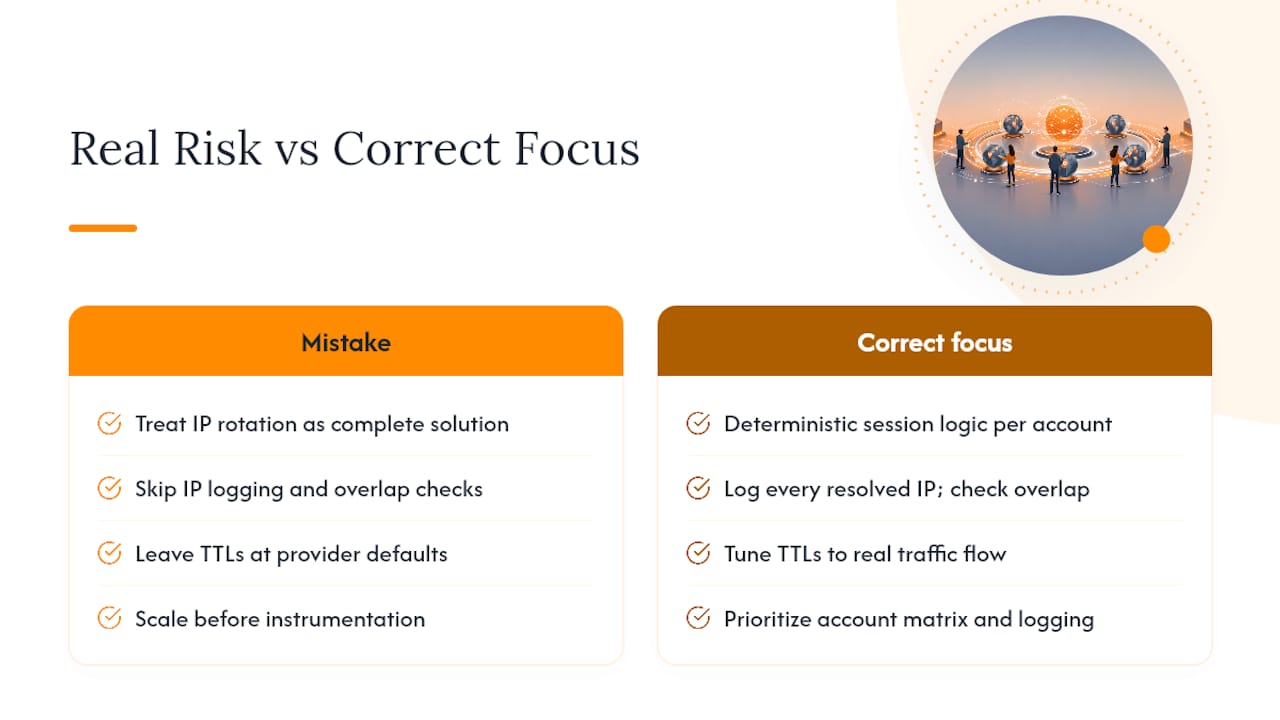
Most teams get the proxy part right and still get banned, and the pattern is consistent enough to call it out directly: they treat IP rotation as the whole solution instead of one layer of it. The conventional advice, "rotate your IPs and you're covered," is incomplete to the point of being misleading. Detection systems correlate signals. An account that rotates IPs cleanly but keeps a stale timezone, a mismatched user agent, or a login pattern that repeats every 47 seconds is easier to flag than one on a single static IP with consistent behavior.
The underrated fix isn't a smarter proxy pool. It's deterministic engineering discipline: the same account always resolving to the same session logic, every resolved IP logged and checked for overlap, and TTLs tuned to the actual flow rather than left at a provider default. Teams that skip the logging step almost always discover their overlap problem after a wave of bans, not before.
If you're building this for the first time, prioritize the account matrix and IP logging before you touch scale or orchestration tooling. A small, well-instrumented setup running 20 accounts cleanly will teach you more about your failure modes than a 500-account deployment with no visibility into which proxy served which request.
Get Started With Rotating Proxies for Multi Account Workflows
Building the session and proxy logic described above from scratch costs real engineering time before a single production request goes out. RotatingProxyHub's rotating proxy product gives you that infrastructure already built, with session tokens, TTL control, and country targeting available through the API on day one.
Every plan includes HTTP/S and SOCKS5 protocol support, dashboard and API access for automating your account matrix, and concurrent-session limits that scale from a small pilot to full orchestration. If you're planning a monitoring, scraping, or market research workflow around multiple accounts, pairing your session-management stack with a tool built for account sync and profile management rounds out the fingerprint side of the equation too. Start with the free rotating proxies trial and test the sticky session pattern from this guide against your own account matrix before committing to a plan.
Sources
- Multi-Account Proxies: Setup, Types, Tools & Mistakes (2026)
- Full multi-account stack architecture in 2026: anti-detect, proxies, phones, automation | multiaccountops
- Sticky vs Rotating Proxy Sessions Guide | ProxyHat