

Route Go's net/http through a long-lived Transport that uses a per-request Proxy func or a dedicated per-worker Transport, with credentials that encode session and country flags. Tune connection pooling and bound your concurrency, or every proxied request pays a fresh TLS handshake tax.
For high-volume scraping and monitoring, a rotating pool spreads requests across thousands of IPs automatically. For multi-step flows like checkouts or paginated sessions, pin a sticky session so the exit IP stays constant for the duration of the task. Either way, credentials belong in the proxy URL, not scattered across your codebase.
- Use one shared
http.Transportper worker or per session, never a new client per request. - Encode session ID and country code in the proxy username, following your provider's format.
- Rotating Proxy Hub supports both modes over HTTP/S and SOCKS5, with API and dashboard access documented on the Rotating Proxy Hub product page.
Key Takeaways
A shared http.Transport with per-request proxy identity, tuned connection pooling, and bounded per-domain concurrency is what makes a Go proxy client reliable at scale.
| Point | Details |
|---|---|
| Use one transport, not many | Share a long-lived http.Transport per worker instead of creating a client per request. |
| Raise MaxIdleConnsPerHost | Go's default of 2 idle connections per host is too low for concurrent proxy traffic. |
| Cap per-domain concurrency | Start at 2 to 4 requests per domain per proxy to limit detection risk. |
| Match session mode to the task | Use rotating sessions for broad scraping and sticky sessions for multi-step flows. |
| Rotating Proxy Hub fits both patterns | Its username-encoded session and country flags and SOCKS5 support work directly with the Transport.Proxy and worker-per-session code shown here. |
How Do You Route A Golang HTTP Proxy Through Go's Net/Http?
The cleanest pattern sets Transport.Proxy to a function instead of a static URL. That function reads an identity, such as a session ID, from the request context and builds a proxy URL on the fly.
func proxyFunc(ctx context.Context) func(*http.Request) (*url.URL, error) {
    return func(req *http.Request) (*url.URL, error) {
        sessionID := ctx.Value(sessionKey).(string)
        proxyURL := fmt.Sprintf("http://user-session-%s-country-us:[email protected]:8000", sessionID)
        return url.Parse(proxyURL)
    }
}

client := &http.Client{
    Transport: &http.Transport{
        Proxy: http.ProxyURL(mustParse(proxyURL)),
        MaxIdleConnsPerHost: 20,
        IdleConnTimeout:     90 * time.Second,
    },
}
A worker-per-session design fits high-concurrency jobs better than a single shared client. Each goroutine owns its own http.Client and Transport, pinned to one session ID for the life of that worker.
- Spin up N workers, each with a dedicated transport and a fixed session string baked into its proxy URL.
- Route work into each worker over a channel so identity never leaks between goroutines.
- Close idle workers gracefully so their connections drain back to the pool instead of leaking.
Colly users get the same behavior through c.SetProxyFunc, which lets you swap proxies per request rather than relying on a static round-robin list, as ProxyHat's Colly guide demonstrates.
SOCKS5 needs a different code path. net/http has no native SOCKS5 support, so pull in golang.org/x/net/proxy:
dialer, _ := proxy.SOCKS5("tcp", "gw.example.com:1080",
    &proxy.Auth{User: "user-session-42", Password: "PASS"}, proxy.Direct)
transport := &http.Transport{Dial: dialer.Dial}
SOCKS5 handles the CONNECT handshake for TLS differently than an HTTP proxy does, since it tunnels raw bytes rather than reissuing HTTP headers. Always wrap requests in context.WithTimeout and call io.Copy(io.Discard, resp.Body) before resp.Body.Close() so the underlying connection actually returns to the pool.
Which Transport Settings Prevent Handshake Overhead?
Share one long-lived http.Transport and http.Client across your whole program, or at minimum across each worker. Building a new client per request throws away connection reuse entirely and forces a fresh TLS handshake on every single call, which is brutal at scale.
Four fields matter most:
- MaxIdleConnsPerHost: Go's default is a stingy 2, which strangles throughput the moment you run more than two concurrent requests per proxy endpoint. Raise it to match your per-host concurrency, since Go pools connections per proxy URL and each distinct URL gets its own idle pool.
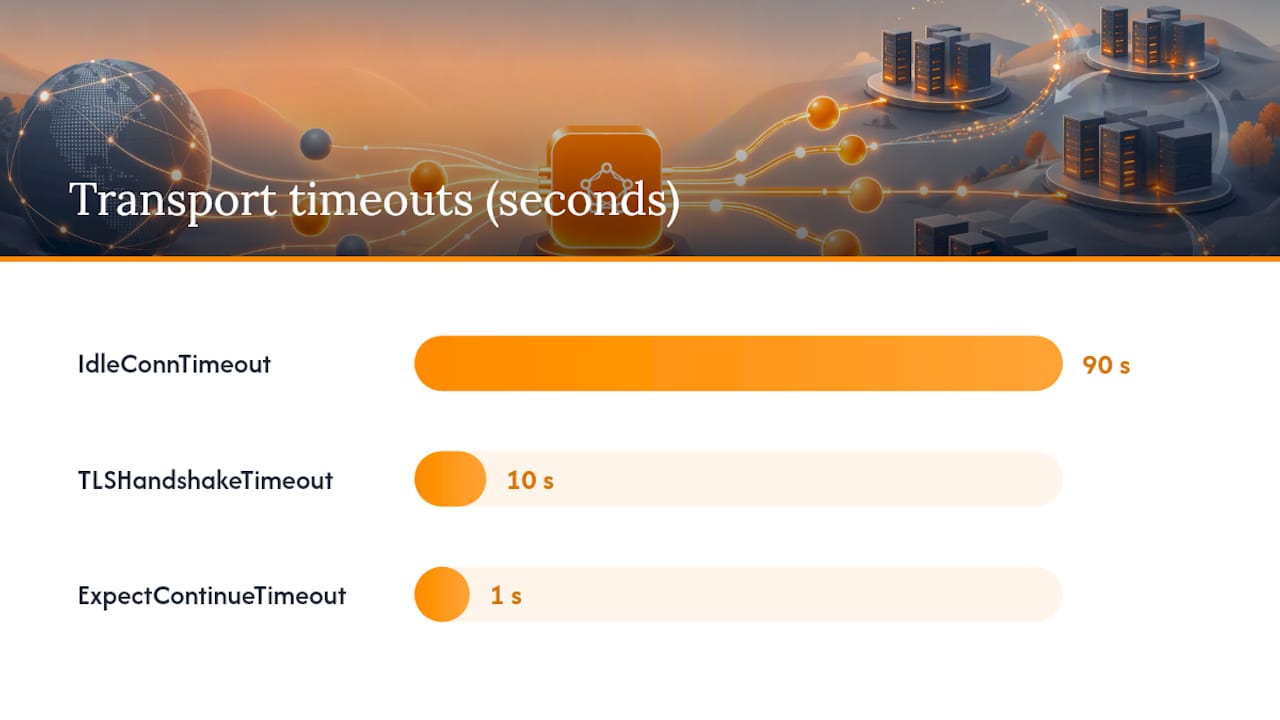
- IdleConnTimeout: 90 seconds is a reasonable starting point; too low and you rebuild connections constantly, too high and you hold sockets your proxy provider may already have recycled.
- TLSHandshakeTimeout: 10 seconds keeps a slow handshake from stalling a whole worker.
- ExpectContinueTimeout: 1 second is standard and rarely needs tuning.
Because pooling happens per proxy URL, every unique session or country string you encode creates its own connection pool. That's fine for a handful of sticky sessions, but if you generate a new random session ID on every request, you'll spin up pools faster than Go can idle them out.
Pro Tip: Drain and close every response body, even on error paths and non-200 status codes. A single leaked body per goroutine, multiplied across thousands of requests, is the single most common cause of "why did my proxy pool exhaust its idle connections" bugs.
How Should Goroutines Map To Proxy Sessions?
Two concurrency models cover most workloads: fixed workers pinned to session IDs, or a dynamic pool that grabs a fresh identity per request for maximum IP diversity. Pinned workers suit login flows and pagination; dynamic rotation suits broad scraping where every request should look like a different visitor.
- Start conservative on per-domain concurrency, roughly 2 to 4 requests per domain per proxy, a figure that shows up consistently in production Colly deployments as a starting point before anti-bot systems start flagging traffic.
- Enforce that cap with a buffered channel acting as a semaphore, or an
errgroup.GroupwithSetLimit, rather than trusting goroutines to self-regulate. - Wrap every request in
context.WithTimeout, and wrap retries in exponential backoff rather than hammering a failing endpoint immediately. - If you're using Colly, combine its built-in
Limitrule (which handles delay and parallelism per domain) withSetProxyFuncfor identity rotation, giving you framework-level politeness and proxy diversity in the same crawler.
Proxy-pool clients like go-proxator take this further with performance-weighted routing: endpoints get scored by success rate and latency, and repeatedly failing endpoints get an escalating cooldown instead of continued traffic. That pattern is worth borrowing even if you write your own pool manager.
Sticky Sessions Or Rotating Sessions: Which One Fits Your Job?
Rotating sessions maximize IP diversity, which is what you want for broad scraping, price monitoring, and ad verification runs that hit thousands of unique pages. Sticky sessions hold one IP for a set duration, which multi-step flows like logins, cart checkouts, or paginated search results require to stay coherent.
- Rotating Proxy Hub and similar gateways typically expose these modes through username conventions, something like
user-session-abc123-country-de, or through distinct ports for rotating versus sticky pools, a pattern also common across other Go proxy SDKs. - Set a session TTL that matches your task length. A five-minute checkout flow doesn't need a 30-minute sticky session; shorter TTLs recycle IPs faster and reduce the chance any single one gets flagged.
- Generate session IDs with enough entropy that two workers never collide on the same string, a UUID fragment or a hashed worker index works fine.
- Datacenter proxies are fast and inexpensive for internal APIs and low-friction targets, but residential proxies handle harder anti-bot targets better, at higher cost and lower speed. Choose based on how aggressively your target site fingerprints traffic.
What Should You Check When A Golang HTTP Proxy Client Fails?
Most failures trace back to five things, in roughly this order of likelihood.
- Confirm the proxy URL, port, and auth string are correct for the mode you intend, rotating and sticky endpoints often use different ports entirely.
- Check that your session or country flags are actually encoded the way your provider expects; a malformed username silently falls back to default routing on some gateways.
- Raise
MaxIdleConnsPerHostif you see repeateddial tcp: connection reseterrors under load, and confirm every response body gets drained before closing. - A
429usually means back off and retry with jitter; a403more often means the session got flagged and needs rotation, not just a retry; a5xxfrom the proxy gateway itself typically clears within seconds. - Log proxy endpoint, session ID, status code, and latency on every request. Without that, diagnosing which endpoints are underperforming turns into guesswork instead of a quick dashboard check.
When Should Proxy Logic Live In Go Versus Get Offloaded?
Keeping proxy rotation inside your Go orchestration layer works well right up until anti-bot defenses get serious, TLS fingerprinting, JS challenges, headless rendering. At that point, maintaining your own solution starts costing more engineer hours than it saves. A reasonable architecture keeps Go as the orchestrator and calls out to a specialized fetch or rendering engine only when a target demands it.
Rotating Proxy Hub's API and sticky/rotating port model support either posture. Simple targets stay entirely in your Go transport layer; harder ones can route through the same proxy pool while a separate service handles the browser-level challenges. You don't have to commit to one architecture for every job in your pipeline.
— Daniel
Put Your Go Transport Patterns On A Proxy Pool That Actually Scales
Every pattern above, the per-request Proxy func, the worker-per-session model, sticky and rotating identity strings, assumes a proxy backend that supports those exact credential conventions. Rotating Proxy Hub's gateway accepts username-encoded session and country flags over both HTTP/S and SOCKS5, so the code in this article drops in against a live pool of more than 50,000 datacenter IPs without rewriting your Transport.Proxy logic.
Concurrent session limits map directly to the worker counts you set in your Go pool, and unlimited bandwidth means you're never re-architecting your concurrency caps around a data ceiling mid-project. If you're monitoring competitor pricing or verifying ads across regions, the website monitoring use case walks through session TTL choices that pair well with the sticky session patterns covered here.
Start with the free rotating proxies trial to test your Transport.Proxy function against real rotating IPs, then move to the rotating proxies plan once your concurrency numbers are dialed in.
Sources
- go-proxator (proxy-pool client for Go)
- Colly — a comprehensive guide to high-performance web crawling in Go